Asthma, Pranayama and my practice

href=”https://essentialyogastudio.blog/wp-content/uploads/2013/12/snow-prana.jpg”>ImageImage

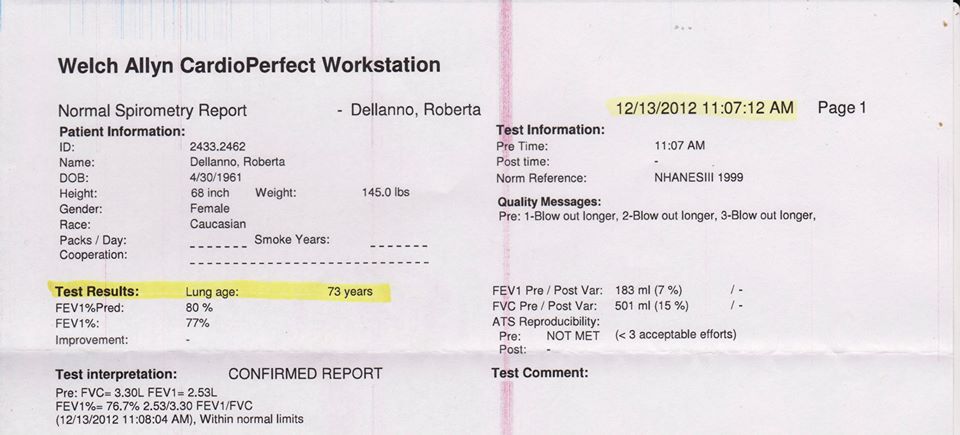
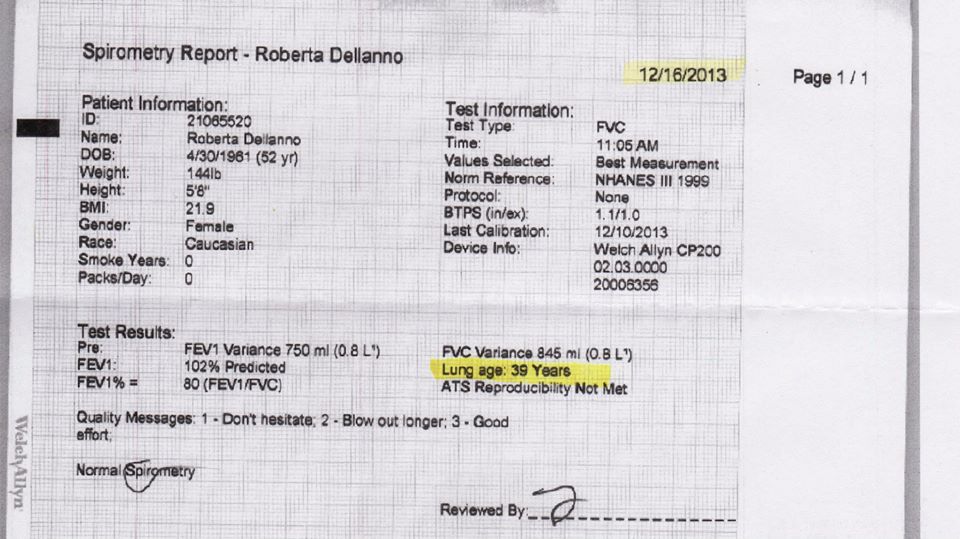
I’ve always had asthma and throughout the years doctors have told to use an inhaler.  I never did.    I’ve always been on the low end of normal with each lung capacity test I’ve taken.   But last year I flunked it – really flunked it.  My doctor told me I needed to use an inhaler.  Instead, I increased my Pranayama practice to 3 times per day, focusing on Ujjayi and Viloma Pranayama stages I & II.  In addition, I increased the difficultly and frequency of my hiking treks.  

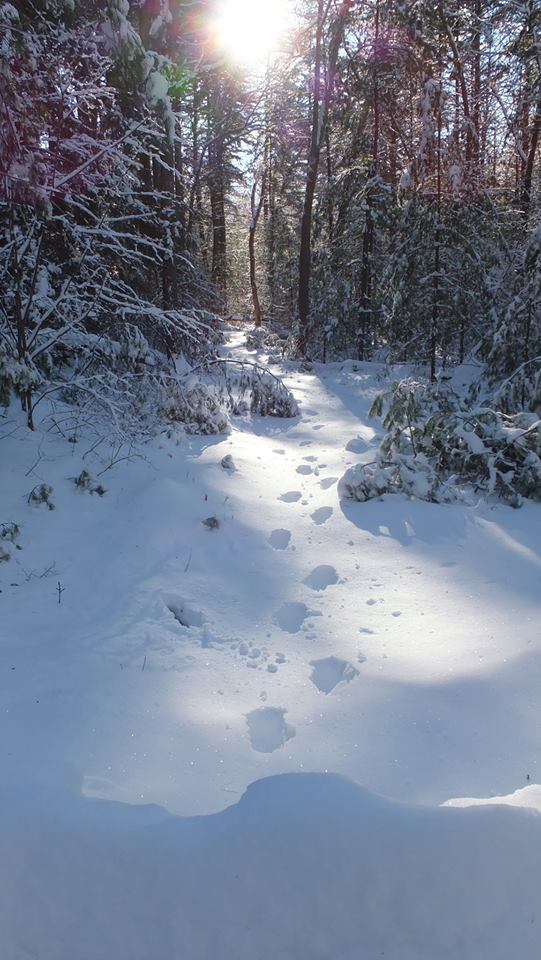
Today at the age of almost 53, I not only passed it, but I have the lung capacity of a healthy 39 year old.   To celebrate, I went snowshoeing.   I stopped and stood in the middle of the woods to practice Ujjayi  Pranayama with my eyes closed  listening to the sound of the woods and my breath.  I stood there for a long time, then I made snow angels <3.


Image


lungtest 2012lungtest 2013

<a

Posted in Uncategorized | Tagged , , , , , , | 1 Comment

Why do you demonstrate on your less than perfect side?

Over the last few years I have demonstrated an asana or two in class, (in particular standing postures or twists) on my less than open side.  For example, I’ll demonstrate Ardha Chandrasana, and discuss where my body needs to move in the pose.  Then I’ll move to the wall to show how the wall helps connect the mind to the body bringing awareness and understanding of how the body needs to work in the pose.    This has prompted comments from some teachers.  Most interestingly, “Why would you show imperfect poses to your students?”

As teachers we are tempted to demonstrate poses on the side that comes easiest to us.  However if we continue to demonstrate poses on the same side, over and over again, in time we will create or increase imbalances in our own bodies.

Many teachers have students volunteer to demonstrate poses.   This is ideal.  You can have students of varying levels of ability demonstrating variations of the pose.  I do this in class on occasion.  However,  I find that most students do not want to be the center of attention in class.

Additionally, I have had students say: “Oh you can do anything”, “Your practice is perfect”, “Everything comes easily for you and I’ll never be able to do that.”   I want students to understand that no one is perfect.  We all have things we need to work on and strive toward in our practice and in our daily lives.  We are, and should be, in a continuous dance of evolution and involution.

Pattabhi Jois said it best:  “Yoga is an internal practice. The rest is just a circus.”

Posted in health, meditation, Uncategorized, wellness, yoga | Leave a comment

B.K.S. IYENGAR SEQUENCE FOR DEEP DEPRESSION

Viparita Dandasana – with support of chair and bolster for the head; hold for five minutes.

Lying over Cross Bolsters; hold for five minutes

  1. Shoulders in mid air, legs bent, feet flat on floor
  2. Shoulders in mid air, legs straight
  3. Shoulders on floor, legs bent, feet flat on floor
  4. Shoulders on floor, legs straight

Salamba Purvottanasana – with 2 chairs, mat, bolster, blanket and plate weight for feet to push against; hold for five minutes (also one chair variation)   Youtube video:  http://youtu.be/tewAuQ3K4fA

Urdhva dhanurasana – with sacrum supported by backrest of chair, bolster on seat of chair; stay as long as you can but less than five minutes; repeat several times; note that feet may come off the floor and dangle in the air.  Youtube video: http://youtu.be/XvKkvj0fxU4

Drop over from Tadasana into Urdhva Dhanurasana and come back up 5 to 10 times. Youtube video using a slant board: https://youtu.be/xkeZuT3o7sI

If unsupported dropping over and coming back is not accessible to you do all of the following.

  1. Urdhva Dhanurasana over a chair – with shoulder blade area supported by backrest of chair; use hand on the wall to come up. Youtube video: http://youtu.be/64PyvZMf9sc
  2. Drop over from Tadasana into Urdhva Dhanurasana with hands holding upper ropes.
  3. Drop over from Tadasana into Urdhva Dhanurasana with lower rope supporting sacrum. https://youtu.be/_uJyn9E-oQA

Sirsasana   Youtube video: http://youtu.be/s637JaYh3ZQ

Adho Mukha Vrksasana   Youtube video: http://youtu.be/5y9A5RES3TE

Urdhva Dhanurasana or Viparita Dandasana or Urdhva Dhanurasana into Viparita Dandasana  Youtube video: added Eka Pada variation.  https://youtu.be/QUAJDitqjis

Nirlamba Sarvangasana II and Ardha Halasana back and forth between the two.  Youtube video: http://youtu.be/9epbgKffqVQ

Paschimottanasana to Halasana 20 times at a fairly quick pace.  “You have to make the their brains light” B.K.S. Iyengar.  Youtube video: https://youtu.be/oRXZZUf8bME

Setu Bandha Sarvangasana– with the support of a block under the sacrum Youtube video:  added Eka Pada variation.  http://youtu.be/pSC8uEoz_58

Posted in Uncategorized | Tagged , , , , , , , , | 6 Comments

Why you should stretch your tongue – and this is how to do it!

Why you should stretch your tongue – and this is how to do it!.

Posted in Uncategorized | Leave a comment

Workshops with Senior Iyengar Yoga Teacher Sri Arun H.S.

arun parivrtta janu sirsasana

I am honored to announce that Sr. Iyengar Teacher Sri Arun H.S. will be teaching two workshops at EssentialYoga Studio during his U.S. tour. These will be small intimate workshops with limited space.

When:  Monday, October 7th  4:00PM – 7:00PM

Tuesday, October 8th 4:00PM – 7:00PM

Cost:   $60.00 for one workshop.  $110 for both workshops.

Sri Arun is a long time student of B.K.S. Iyengar and is one of a handful of Advanced Iyengar teachers in the country – which means his certification comes directly from BKS Iyengar.

Don’t miss this opportunity to experience yoga with this celebrated and innovative Yoga Master.

To register send a check to: Roberta Dell’Anno,
EssentialYoga Studio
18 Fosters Pond Road
Andover, MA 01810

About Arun H.S.

Sri Arun began teaching yoga in 1976. He conducted a class in the presence of B.K.S. Iyengar in 1978 which inspired a lifelong study with Guruji.

He is the Founder and Principle instructor at the Prashant Yogashraya in Bangalore, India.

Arun is known for taking a personal interest in every student he encounters. He quickly develops an understanding of each student’s particular strengths and weaknesses and skillfully guides them according to their capabilities. Arun’s students appreciate him for his ability to connect and teach from the heart, as well as for his quick-witted sense of humor.

His workshops offer a well balanced, challenging, deep, (sometimes restorative) and powerful class. He is very attentive to every student in the room. During his workshops students will experience a full understanding of a wide spectrum of asanas including standing poses, forward-folds, twists, inversions and backward bends. Active use of props is a dominant theme in Arun’s practice.

“As I started teaching yoga, I saw different kinds of human bodies and thousands of complex minds; despite the apparent similarities between people I saw that each individual has very distinct needs” -Yoga Praveena Arun H.S.

Questions:  Call Roberta Dell’Anno at  978-337-2331 or email  EssentialYoga@comcast.net.

Posted in health, meditation, Uncategorized, wellness, yoga | Tagged , , , , , , , , , , | Leave a comment

a yoga sequence …for times of crisis

In an email from Patricia Walden:
“Patricia suggests that at times like this, yoga practice can be our refuge, helping us to connect with our inner light and to find equanimity. Yoga helps us to remain seated in ourselves. When we practice, we are practicing for our own wellbeing, but we can also offer our practice to others, to make of our soul a lighthouse. 
Several years ago, a yoga sequence …for times of crisis was given to us by Guruji. We share the sequence with you now in the hope that it may be of help to all of us. (Please refer to BKS Iyengar, Yoga: The Path to Holistic Health, (revised edition, 2008), DK Publishing, for supported versions of the asanas).
Notes: 1. The emotional strength in these students need to be built up and that is what we need to work [on]. 2. No standing poses. No backbends. 3. All poses should be done with eyes open (including savasana). [Students] can focus their eyes at any point in front or on the ceiling. 4. Ask the students to imagine [that] their eyes are located at the temples and ask them to “open” these eyes. 5. Do not insist on a perfect pose in the current situation. 6. While breathing in any asana (especialy supine) — ask [students] to breathe in such a manner that the breath touches the lateral side of the chest during inhalation. 
 
Here is the sequence:
1. Savasana (corpse pose; can be done supported on a bolster or blankets)
2. Supta baddha konasana (reclining bound angle pose; can be done supported on a bolster or blankets)
3. Supta virasana (reclining hero pose; can be done supported on a bolster or blankets)
4. Prasarita padottanasana (with head support; wide-leg standing forward bend pose)
5. Uttanasana (with head support and legs spread apart; standing forward bend pose)
6. Adho mukha svanasana (with head support; downward facing dog pose)
7. Viparita dandasana supported by a chair (with head support; inverted staff pose)
8. Sirsasana – viparita karani (headstand; if you’re unfamiliar with the viparita karani version of this pose, do regular sirsasana)
9. Setu bandha sarvangasana (supported bridge pose)
10. Sarvangasana- viparita karani (shoulderstand; can be done supported on a chair; if you’re unfamiliar with the viparita karani version of this pose, do regular sarvangasana)
11. Pranayama: Antara kumbhaka with a very short kumbhaka on the inhalation”
 
Om shanti….
Posted in Uncategorized | Leave a comment

Question of the Month: How do I keep from becoming discouraged in my practice? I look around in yoga class and I can’t do any of the poses.

This is a difficult question to answer.  Yoga is internal, personal, and not to be compared to the practice of the person next to you.  While in India, I was always looking around at the other students.  Geeta Iyengar told me to keep my eyes on my own mat. She asked (in a way only Geeta can ask), “How can you be aware of what’s going on in your own body if you are busy looking around the room at the other students?”  We have to learn to be attentive to our own practice, notice the imbalances and limitations in our own body and approach our practice like a puzzle.  With an internal practice our body will begin to fit together all of the pieces that didn’t quite fit right in the beginning.

We have to take control of our practice and know there are some things our bodies aren’t ready for yet.  I attend a teacher’s class taught by my primary teacher Zoe Stewart.  She told us to come into Sirsasana and bring our legs into Padmasana.  Padmasana is a difficult pose for me just sitting on the floor and Sirsasana is difficult for me all by itself without adding something else to it.  So I went into Sirsasana, stayed, enjoyed, came down.  I then sat on the floor and practiced Padmasana preparation poses.  My teacher asked why I wasn’t practicing the pose in Sirsasana.  I told her it was a ‘pose for tomorrow’, for today I will practice this way.  

Sometimes the most advanced yogis are the ones with the least impressive poses.  They focus on where they stand on the path without looking ahead.  Sometimes, the most wonderful place is the one you are standing in right now.  That’s not an easy thing to teach, it’s personal, it comes with practice, with disappointment, with a practice waxing, waning then waxing again. It comes with that one fleeting moment of Samadhi.  It comes without judgement or caring how a pose looks, only how it feels on the  inside.

In your next class, move into each pose, then close your eyes, how does it feel on the inside?  That’s  important.  That is where you will find the desire, the joy, and the determination to practice. 


Posted in meditation, Uncategorized, wellness, yoga | Tagged , , , , , , | 1 Comment

Question of the Month: I find Digital Pranayama difficult. Why can’t I practice closing the nostrils with the thumb and forefinger? What is the importance of Digital Pranayama?

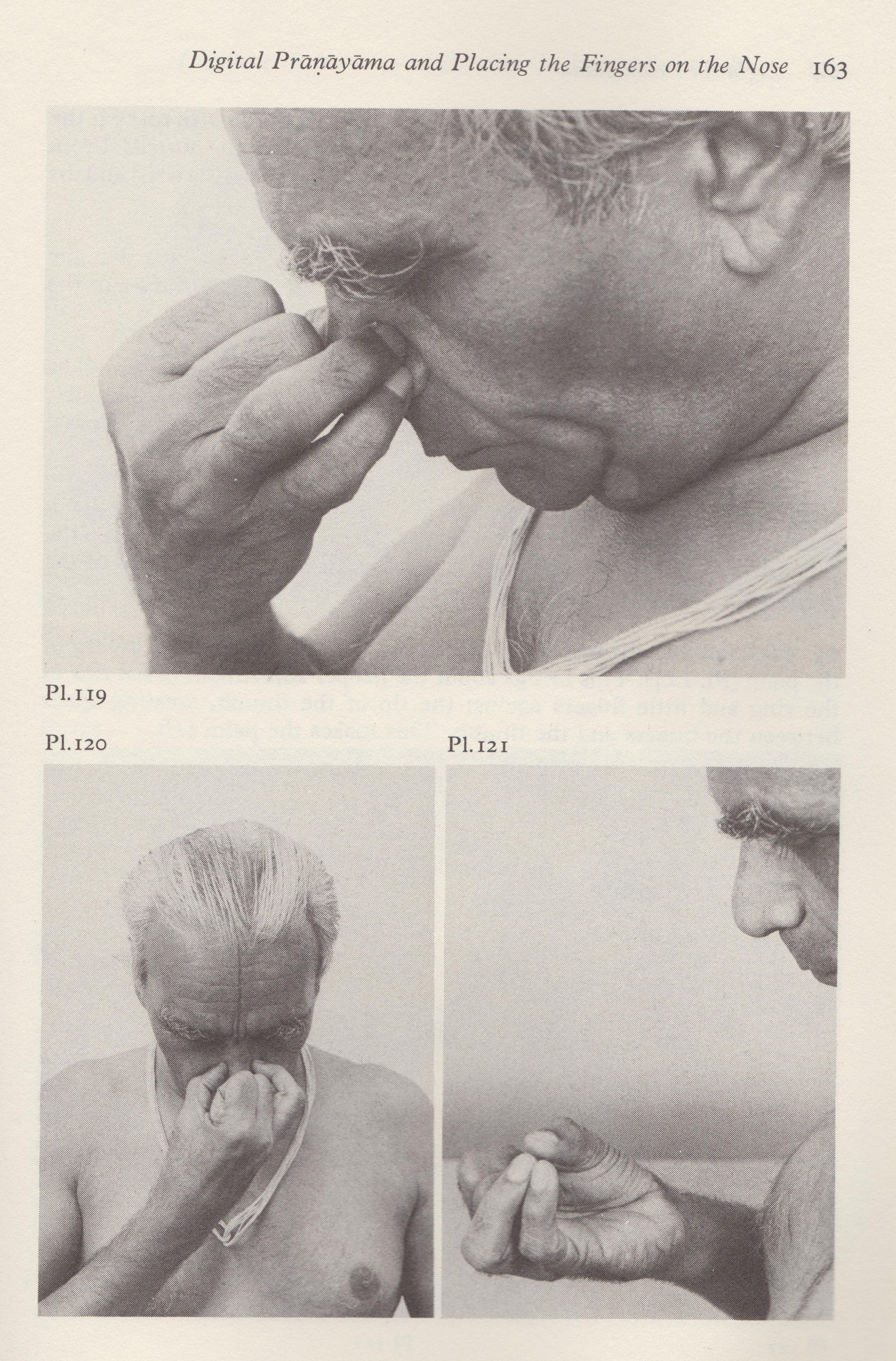
Proper Hand Placement in Digital Pranayama


In the practice of digital Pranayama the fingers regulate the volume and flow of breath by narrowing the nasal passages filtering out impurities during respiration. The controlled inhalation through the narrowed passages allows the lungs more time to absorb oxygen. In controlled exhalation, unused oxygen is reabsorbed and waste matter is ejected.

Yoga texts such as Gheranda Samhita recommend the use of the thumb, ring and little fingers on the nose and stress that the fore and middle fingers are not to be used. If the fore and middle fingers are used, the forearm and wrist tilt and become heavy making it difficult to hold the arm up. In addition, the correct and accurate pressure cannot be applied to the nostrils since the nose pulls the fingers down and accuracy in the performance of Pranayama is lost. Similarly, keeping the fore and middle fingers on the center of the forehead or extended outward creates varying pressures on the thumb, ring, and little fingers causing an uneven curvature of the digits and an irregular flow of breath.

When practicing digital Pranayama, the fore and middle fingers are folded into the hollow of the palm, with the thumb resting on the right side of the nose and the ring and little fingers on the left, with the wrist placed centrally. This enables the thumb, ring and little fingers to move on either side smoothly and freely.

BKS Iyengar compares the mastery of digital Pranayama to a master musician. A musician studies the construction, shape, stops and other characteristics of his instrument as well as the atmospheric changes that affects it. In practicing digital Pranayama we ‘play’ the nostrils delicately fingering them to manipulate breath patterns as if playing the flute, adjusting the flow, rhythm and resonance of breath.

Benefits of Digital Pranayama
• The blood receives a larger supply of oxygen than in normal breathing soothing and invigorating the nervous system (making it particularly beneficial for individuals with neurological disorders)
• The mind becomes still and lucid – increasing focus and concentration
• It increases digestive power
• Cleans the sinuses
• Boosts energy and lifts the spirits
• Lowers heart rate and reduces stress and anxiety
• Synchronizes the two hemispheres of the brain
• Increases lung capacity and the efficiency of the diaphragm
• Purifies the subtle energy channels (nadis) of the body so the prana flows more easily during pranayama practice
• It develops the strength of will-power, determination, stability, it helps control the senses, and leads toward self knowledge

Posted in health, meditation, Uncategorized, wellness, yoga | Tagged , , , , , | Leave a comment

Learning to Float up into Adho Mukha Vrksasana (Handstand)

Using a chair, bolster, and wall to help engage the abdominal muscles to float up into Adho Mukha Vrksasana

Posted in health, Uncategorized, wellness, yoga | Tagged , , , , , | Leave a comment

Sr. Iyengar Yoga Teacher Father Joe Pereira

In September, I will be driving 12 hours to Chester, Nova Scotia to attend my second workshop with Father Joe Pereira, a Sr. Iyengar Yoga Teacher from India.

He is a very special yoga teacher who is also a Catholic priest. I never imagined a priest quoting Patanjali’s Yoga Sutras. His perspective on yoga and his teachings are very different from my North American teachers. I found the stories of his many years of travel with Mother Teresa and his longtime friendship and teaching with BKS Iyengar inspirational.

He told a story about breaking his back working with Mother Teresa. The doctors informed him he would need surgery and permanent metal supports would be inserted to steady his spine. He thanked the doctors and took the scan to BKS Iyengar. Mr. Iyengar looked at the scan and said, “26 asanas” and wrote the asanas right on the scan. Father Joe practiced these 26 asanas everyday for an hour and a half. He hung ropes and placed props outside the rectory. Mother Teresa got many comments from the villagers asking, “What kind of priest hangs from ropes like a bat?”

One of the students in the workshop asked how long it took to heal his back with these asanas. He said It took 2.5 years. The students gasped. He replied by saying that we North Americans don’t have fidelity in our practice. We want things fixed right away – resulting in a high percentage of shoulder surgeries, knee replacements and back surgeries in our country. The discussion went on, but it was his comment about our need to fix things quickly and our lack of ‘fidelity’ or commitment that struck me. We move so quickly through our lives, we have a need to do everything now, the need to be first in line, the need to rush through the light before it turns red, the need to place the hand on the floor in Triangle pose (Utthita Trikonasana) before our bodies are ready…… We need to learn to be present.

Posted in Uncategorized | 1 Comment