Meditation, Cortical Thickness, and Pain Sensitivity

There’s a small but growing body of research literature showing that meditation practice is associated with greater cortical thickness in the brain (i.e., Grant et al., 2010; Lazar et al., 2005; Pagnoni & Cekic, 2007). All three studies used MRI scans to examine brain structures. In Lazar et al. (2005), a group of Insight meditation practitioners, regions of the brain associated with attention and sensory processing exhibited an increased thickness compared to a control group matched for gender, age, race, and years of education. Interestingly, the average thickness in the prefrontal cortex in 40-50 year-old meditators was similar to the average thickness of 20-30 year-old meditators and controls. This suggests that practice may slow age-related degeneration of brain tissue. Pagnoni & Cekic found a similar pattern in Zen practitioners.

More recently, Grant et al. (2010) examined the relationship between cortical structures and pain sensitivity in meditators. The researcher first compiled a list of 68 meditators willing to participate. In order to have a more homogenous sample, they chose Zen practitioners, who both made up the largest tradition in the list and reported more than 1,000 hours of meditation experience. Of the 19 Zen practitioners, 17 participated; these were matched against 17 non-meditators for age and gender.

A computer controlled increase in temperature, which was designed to create a moderate level of pain, was applied to the inner left calf of each participant. Cortical size was measured using MRI scans.

Zen practitioner exhibited lower pain sensitivity than controls. On average, Zen practitioners required an increase to 50°C in order to report a moderate level of pain; controls required an average of 48°C. Lower pain sensitivity was also related to greater cortical thickness, particularly in the dorsal anterior cingulated cortex, right anterior insula, and bilateral hippocampal formation. Greater thickness in these areas was related to greater meditation experience. Because this was a cross-sectional study and not a true experiment, we can’t be certain that there is a causal relationships between meditation experience, cortical thickness, and pain sensitivity. Taken together, the authors suggest that long-term meditation practice may lead to changes in the brain structures, which in turn may lower sensitivity to physical pain. The full article can be read in the most recent edition of the scientific journal Emotion. Interview excerpts with the first author about this study can be found at Science Daily.

This article, along with more information, can be found at http://www.ScientificMindfulness.com

The citations for the articles are:
Grant J.A., Courtemanche J., Duerden, E.G. Duncan G.H., & Rainville, P. (2010). Cortical thickness and pain sensitivity in zen meditators. Emotion, 10(1), 43-53.

Lazar, S. W., Kerr, C. E., Wasserman, R. H., Gray, J. R., Greve, D. N., Treadway, M. T., et al. (2005). Meditation experience is associated with increased cortical thickness. Neuroreport, 16(17), 1893-1997.

Pagnoni, G., & Cekic, M. (2007). Age effects on gray matter volume and attentional performance in Zen meditation. Neurobiology of Aging, 28(10), 1623-1627.

Posted in meditation | Tagged | Leave a comment

Notes taken at a Menopause Workshop with Sr. Iyengar Teacher Patricia Walden

Menopause workshop with Patricia Walden. March 27th
Please note: Any omissions or mistakes are clearly my error not Patricia Walden’s.
Patricia’s book, “Woman’s Book of Yoga and Health”

During menopause, it is important to laugh hard and laugh often. Diet is important, less fat, more whole grains, more vegetables.

Symptoms of Menopause:
• Body has less freedom
• Posture (pay attention to it – this is when the spine starts to round)
• Joint stiffness
• Night sweats
• Can’t find the words when you speak
• Depression, melancholy
• Mourning your youth
• Anxiety
• No desire for sex
• Vaginal dryness
• Memory lapses
• Self doubt
• Rapid heartbeat
• Insomnia
• Fatigue
• PMS – symptoms are much worse
• Mood swings
• Irritability
• Incontinence
• Weight gain
• Hair loss or hair thinning
• Osteoporosis
• Exacerbation of all conditions
• Changes in metabolism
• Peri-menopause can last up to 10 years
• You are in menopause if you don’t have a period for 1 year
• You will need to take off your bra and unzip the jeans. Tight clothes bring on hot flashes

Things you can do.
• Bond with other women
• Stay healthy
• Change diet
• Exercise
• Do less – enjoy more
• Journal your symptoms and experiences
• Nurture yourself daily

Menopause sequence for Hot Flashes
• Supta baddha konasana cross arms overhead and remain up to 10 minutes. This is a complete pose and the nervous system is relaxed
• Upavista konasana
• Supta padangusthasana 1 – make a loop and place the loop over the arch of the foot. Hold the strap with both hands using the index and middle fingers. Pull the strap and press the arch up at the same time. The outer thigh should move into the socket
• Supta padangusthasana 2 – place a folded blanket under the right buttock to balance the pelvis, bring the left leg into baddha konasana, place the loop on the arch of the right foot (following P1 instructions) extend the right leg out to the side (along side of the hip, not up toward the ear.
• Supta Padangustasana 2 – same instructions except the left leg is straight and angled out to the left.
• You can also practice SP2 with the extended foot on the wall either supported with height or without. This is less effort and decentralizes the body.

Sequence for lubricating the hips.
• Prasarita Padottanasana Stage I to Utthita Trikonasana back to PP then to UT on the other side.
• Prasarita Padottanasana Stage II to Virabhadrasana II (hands on hips). While in Vira II, bend and straighten the knee completely several times (This helps lubricate the hips). Then back to PP2 to Vira II on other side. Important, keep the uterus from tipping forward and keep the bent knee from turning in.
• Prasarita Padottanasana Stage II to Utthita Parsvakonasana (repeat on the other side)
• Prasarita Padottanasana Stage II to Arch Chandrasana (this is the quintessential pose for women it creates a horizontal spreading of the hips.) Practice at a wall. Teacher adjustment, strap in groin of standing leg and pull straight up.
• Prasarita Padottanasana Stage II to Parsvottanasana (repeat on the other side)
• Prasarita Padottanasana Stage II Parivritta Utthita Trikonasana (repeat on the other side)
• Uttanasana – head support
• Sirsasana
• Halasana (very magical for women going through menopause).
• Shoulder stand (very important practice)

Halasana and Shoulder stand are beneficial for the endocrine system, emotional and mental health.

Supported Back bending – full backbends generate heat and the body may not be able to handle them.

However backbends are very important for mood – they lift the spirits, they also help keep posture healthy.
• Viparita Dandasana with a chair feet at the wall
• Cross bolsters (use either two bolsters, or one bolster and folded blankets) Move lower on the back to spread the abdomen for relieving congestion. Move higher on the back to spread the chest/rib cage to bring energy.
• Setu bandha – hold block between legs @ groin – don’t press the abdomen forward it is bad for the uterus.
• Setu bandha with (4) bolsters is a very important pose. Belt legs on mid thigh and shins. If there is too much stress on the neck. Roll a blanket part way and place the roll under the shoulders and the rest of the blanket under the head. You can also practice by placing your legs in baddha konasana
• Do bharadvajasana on a chair or a blanket

Forward bending Sequence
The mind should be in a quiet state for stress (not anxiety).
• Dog pose head supported
• Adho mukha virasana with 3 bolsters – the toes should hang off of the back bolster and knees should be supported by the middle bolster, the forehead should be supported by the front bolster. The arms should be crossed with the hands holding the elbows. This is very calming.
• Paschimottanasana should be done with a chair and two bolsters. One under the buttocks and one supported by a chair and the floor . This way the head can be supported.
• Paschimottanasana – full. If you are in the full pose have the legs apart. Having the legs together generates heat and this is not good during menopause. Do not do this pose if you are having a hot flash.
• Janu sirsasana should be done the same way as Paschimottanasana.
• DO NOT do poses like Marichyasana I pose because the are too ‘constricting’ – you need to expand the body.

Hot flashes are different from night sweats. Hot flashes are an intense heat that can start at the knees and rise up or from the abdomen and rise up. You cannot function when one hits you. You have to stop and honor your body. Night sweats are when you wake up in the middle of the night soaking wet, you have to take your blankets off, maybe take your clothes off, and possible need a towel to dry off your body.

Ardha Matsyendrasana – Make sure that you are not pushing down on the uterus (muscle: PC ) Good book regarding the pelvic floor: “ Anatomy of the Pelvic Floor”

Viparita Karani & Cycle

Sitting bones should be dropping down – the abdomen should be releasing down between the frontal hip bones.

Create big loop in belt and place the loop on the big toes and stretch the legs out into supta konasana you can also strap the legs in swastikasana and then move to baddha konasana. Remember to keep the abdomen soft.

Wonderful Poses that calm the central nervous system

• Halasana with two chairs legs wide
• Supta Konasana two chair for students who cannot bring their feet to the floor.
• Savasana with legs apart
• Savasana with calves on two chairs legs wide

Mini sequences when you don’t have a lot of time to practice

• Upavista Konasana
• Prasarita padottanasana
• Ardha chandrasana at the wall

• Upavista konasana
• Supta padangustasana II
• Supta baddha konasana

• Adho mukha virasana with bolsters
• Janu sirsasana
• Paschimottanasana
• Upavista konasana
• Bharadvajasana (on chair or blanket – tones the adrenal glands)

• Inversions (very important)
• Sirsasana (or head supported downward dog)
• Sarvangasana (full or on chair)
• Halasana
• Viparita Karani cycle
• Savasana (calves on chairs)

Things to do when you are waking in middle of the night
• Focus on the breath
• Accept the present moment – instead of stressing about not being able to sleep
• Practice the “so ham” mantra
• Focus on slow soft exhalations – exhalations are calming.
• Viloma pranayama stage two

Diet/Food
• Less fat
• More vegetables
• Whole grains – they can change your mental state

Other things you can do
• Surround yourself with positive things.
• Help brain fuzzyness and/or memory loss, you may have to start doing puzzles, sudoku, crossword, etc. to help bring your memory back.
• Walking relieves sluggishness (walking in the woods)

Menopause is a time for Ahimsa, Satya, Asteya
• Don’t be afraid to speak the truth. It is very important. Get rid of things in your life that steal your energy (people and things)

Posted in yoga | Tagged , , , , | 7 Comments

Question of the Month: I know I should meditate, but I don’t know how to go about it. How do I start?

• Establish a meditation corner that you can use every day. It should be a place where you can be relatively undisturbed during your meditation sessions.
• Meditate at the same time everyday.
• Sit as long as you can everyday. Even five minutes of sitting will help you cultivate and maintain your awareness as you continue through the day.
• Determine before you take your seat, how long you will meditate. This will eliminate decision-making during your session.
• You can sit quietly or use a guided meditation tape/cd.
• Keep it simple. Do not try to induce a particular state of mind, just an attitude of openness and curiosity. This will help you let go of judgments, expectations and other obstacles that keep you from being present.

Breath Awareness Meditation, a meditation for all levels of practitioners
With this meditation, your attention is not solely on your breath. You are expanding your awareness to allow yourself to also notice your thoughts.

What does it mean to notice your thoughts? Simply notice every time your mind starts to wander. Rest your awareness on your exhale, and notice your thinking. Don’t get pulled into the stories, the planning, the evaluations. Don’t criticize yourself for thinking. Just become aware. Use the exhalation to keep you connected to the present moment.

Breath Awareness meditation is the first step to understanding how we can direct our internal experience. It is the first step to understanding our unconscious habits. You cannot practice this meditation incorrectly. You are not trying to achieve some transcendental state of bliss. You may find that this meditation produces a mental clarity and a sense of well-being. Sometimes it will, and sometimes it won’t. That is not the point. The point is to practice noticing, and to begin to understand your mind.

Posted in meditation | Tagged , , , | Leave a comment

Commentary: Halsasana Variation-Teachers & Advanced Practitioners

Posted in yoga | Tagged | Leave a comment

HIGHLIGHTS: Manouso Mano’s Iyengar Yoga Workshop, Cranston RI.

Manouso showed an adjustment for Adho Mukha Svanasana that I had never seen before. If I can find a student volunteer, I will make a video of it. Most students who touch their heads onto the floor overstretch/sink into the shoulders. Other students think they can’t touch their head down when, in actuality, they can if they have the proper lift in the shoulders. The adjustment he taught us lifts what he calls the inner shoulder (the trapezius muscles along each side of the neck) and presses down with crossed thumbs at the 1st or 2nd thoracic vertebra. When this is done the student just releases amazingly into a full downward facing dog with the forehead on the floor. It looks pretty dramatic, but when you feel it yourself it’s a comforting release and is incredibly light.

He also taught a variation of Halasana which is being used, with success, on deaf individuals in India. It is also highly effective as a curative for asthma, TMJ and sinusitis (and probably a number of other things that I didn’t note). The thing is, it is supposed to be incredibly uncomfortable, and IT IS. It is an intensely uncomfortable stretch from the occipital ridge all the way down to the mid-thoracic spine. In order for it to be effective, you have to practice it 2x per day, for 5 or 10 minutes, every day. Knowing how it feels to be in this pose, this is a daunting task. Once the practitioner has seen results, they can practice it less often.

I am going to start practicing it for my TMJ and experiment with the results. I may make a video of this but, if I do, I will only distribute it privately to teachers and advanced practitioners, since I would not recommend beginners try this on their own.

These are just two of the things I learned. I will try to put a blog together noting the immense information. I do recommend any teacher interested in learning deep nuances of asana, Pranayama and yoga therapy, to attend any workshop by Manouso. Manouso can be a little cantankerous, and he was during some of this weekend workshop. If you are sensitive to this, GET OVER IT and learn from a Master.

Posted in Uncategorized, yoga | Tagged , , , | Leave a comment

Question of the Month: I don’t like practicing backbends. How important is it that I incorporate them into my practice?

Backbends are an important part of any yoga practice. We don’t bend backwards in our daily lives; it feels much more natural to bend forward (bending to tie shoes or pick things up from the floor, etc). As we age our spines become more rigid and begin to round forward. The regular practice of backbends will free the spine from built up tension and rigidity. Backbends open the hips, strengthen and stretch the legs and lower back muscles. They help the body gain more flexibility, align the spine, and build muscle tone. Along with flexibility and muscle tone, backbends also stimulate the abdomen, kidneys, reproductive and digestive system.

B.K.S. Iyengar uses backbends to cure depression in his students and as a holistic alternative for heart patients. According to Sr. Iyengar Teacher, Father Joseph Pereira, BKS Iyengar suffered more than one heart attack 30 years ago. Rather than have heart surgery he remained in his practice room, on a setu-bandha bench, for several days to “clear blockages in his heart”. (Fr. Joe talked about this during his workshop last September in Nova Scotia.)

In the Astadala Yogamala, Volume 8. B.K.S. Iyengar discusses how backbends massage the heart in a way that running and jogging cannot. Backbends increase the amount of blood circulating to the heart muscles without irritating or making the heart pump faster, and without the tremendous movement of the body used in running or jogging.
__________________________________________
References: Yoga for Inner Strength, J Chapmam; Astadala Yogamala, Volume 8, BKS Iyengar; Light on Yoga, BKS Iyengar.

Instructional Back bending videos

Beginners: Urdhva Dhanurasana Instructional Series 1 & 2

Beginners-Intermediates: Urdhva Dhanurasana Instructional Series 3 & 4

Posted in Uncategorized | Leave a comment

What is the importance of Pranayama?

An excerpt from a BKS Iyengar interview taken from the Astadala Yogamala, Volume 7, says it all.
“…I had tuberculosis as a young man and bouts of other diseases that had compromised my lungs. In 1984 I was in San Francisco for the first Int’l Iyengar Yoga Convention and some doctors insisted I undergo a test to study my lungs. They wanted to see the chemical changes taking place in my body on account of regular practice of asana and pranayama. “Sir, we are sorry to tell you that you are going to live long and our study has shown that your lungs are that of a twenty-four year old athlete.” So when you have such good lungs. You have a long life in front of you. I was already sixty-six at that time….”

For an amazing demonstration of Pranayama by BKS Iyengar watch this video!

Posted in Uncategorized | 2 Comments

Student question: Why do I need to practice hip openers?

Hip opening poses have numerous benefits. They are wonderful for relieving unwanted stress, calming the nervous system, combating fatigue, as well as bringing positive emotional and energetic effects. They prepare a mother’s body for childbirth.

They are important to practice if you sit at a desk all day. Long hours of sitting cause the hip flexors to shorten limiting our ability to extend and possibly affecting the pelvic position and the lower back.

These poses not only open the hip joints, but also help align the pelvis and the sacrum. Students who practice hip openers can immediately experience tangible physical benefits such as greater freedom in their lower back and hips. When the hips are open the sacrum and pelvis are better aligned, you can walk, sit, and move around with more ease and comfort. In addition, opening the hips takes excessive pressure off the knee joints.

Each hip opening posture has its own benefits.

Additional Benefits:
They relieve sciatic and arthritic pain, improve digestion and elimination (example: Utthita Parsvakonasana).

They prevent hernias, keep the ovaries, testicles, kidneys and prostate healthy, open blocked fallopian tubes (example: Baddha Konasana).

They keep the reproductive organs healthy, correct misalignment of the hip joints, decrease the development of uterine fibroids and other diseases of the abdominal organs. They also strengthen the pelvic muscles, tone the internal organs and create elasticity in the hamstrings and inner thighs. (example: Supta Padangustasana II)

Posted in Uncategorized | Leave a comment

Parvatasana

Mental Benefits of Parvatasana
Parvatasana is a whole body stretch that allows good blood circulation, creating several benefits.
· It increases circulation to the brain
· It brings a revitalizing and refreshing sensation reducing mental fatigue
· Improves memory and concentration

Physical Benefits of Parvatasana
It prevents injuries by strengthening several fragile areas of our bodies. The pose stretches calf muscles, hamstring muscles, back muscles, abdominal muscles, forearms, shoulders and wrists.

This asana prevents and relieves carpal tunnel syndrome, rheumatic stiffness and arthritis. It helps relieve pain while increasing mobility of adhesive capsulitis (frozen shoulder syndrome). It can be used for toning almost all of our body’s muscles.

Sitting Position: Padmasana
(Modification: sit in Ardha Padmasana, Sukhasana, Vajrasana)
· Take both the hands forward and interlace the fingers of the hands together.
· Take the hands over the head and turn the palms up. Stretch the body upward with the arms stretching toward the sky. Straighten the arms and open the pit of the elbows as shown in the photo.
· Stabilize the position and continue normal breathing.
· Relax the body and bring the hands down.
· Change the cross legs and the interlacing of the fingers.

Duration
You can remain in this asana for as long as your body allows.

Posted in health, Uncategorized, wellness, yoga | Tagged , , , , , | Leave a comment

What is the correct hand and arm placement in Headstand (Salamba Sirsasana)?

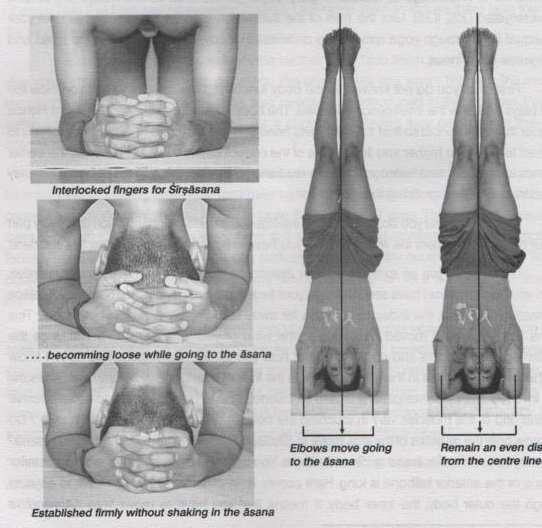
The fingers should be interlocked and fit together without spaces and without gripping. Think of the interlocking of your fingers as the dove-tailing found in fine furniture. The top of the thumbs should touch, not fold over each other. The radius bone at the wrist should be perpendicular to the floor as show in the top left photo.

The fingers should NOT spread apart as shown in the left middle photo. The forearms should be pressed firmly onto the floor from the wrists to the elbows as shown in the left bottom photo.

Watch the elbows as you move into Sirsasana. The elbows should be directly under the shoulders as shown in the above photos on the right. The elbows should remain an even distance from the center line of the body. The moment students move into Sirsasana the elbows shift out away from the shoulders. This will place undo stress on the cervical spine. Refraining from ‘hopping’ up into Sirsasana and keeping the forearms firmly rooted onto the floor will help keep this from happening.

Posted in Uncategorized | Leave a comment